
Systèmes d’information
Concevoir, maintenir et optimiser des systèmes d’information sur infrastructures cloud et hybrides.
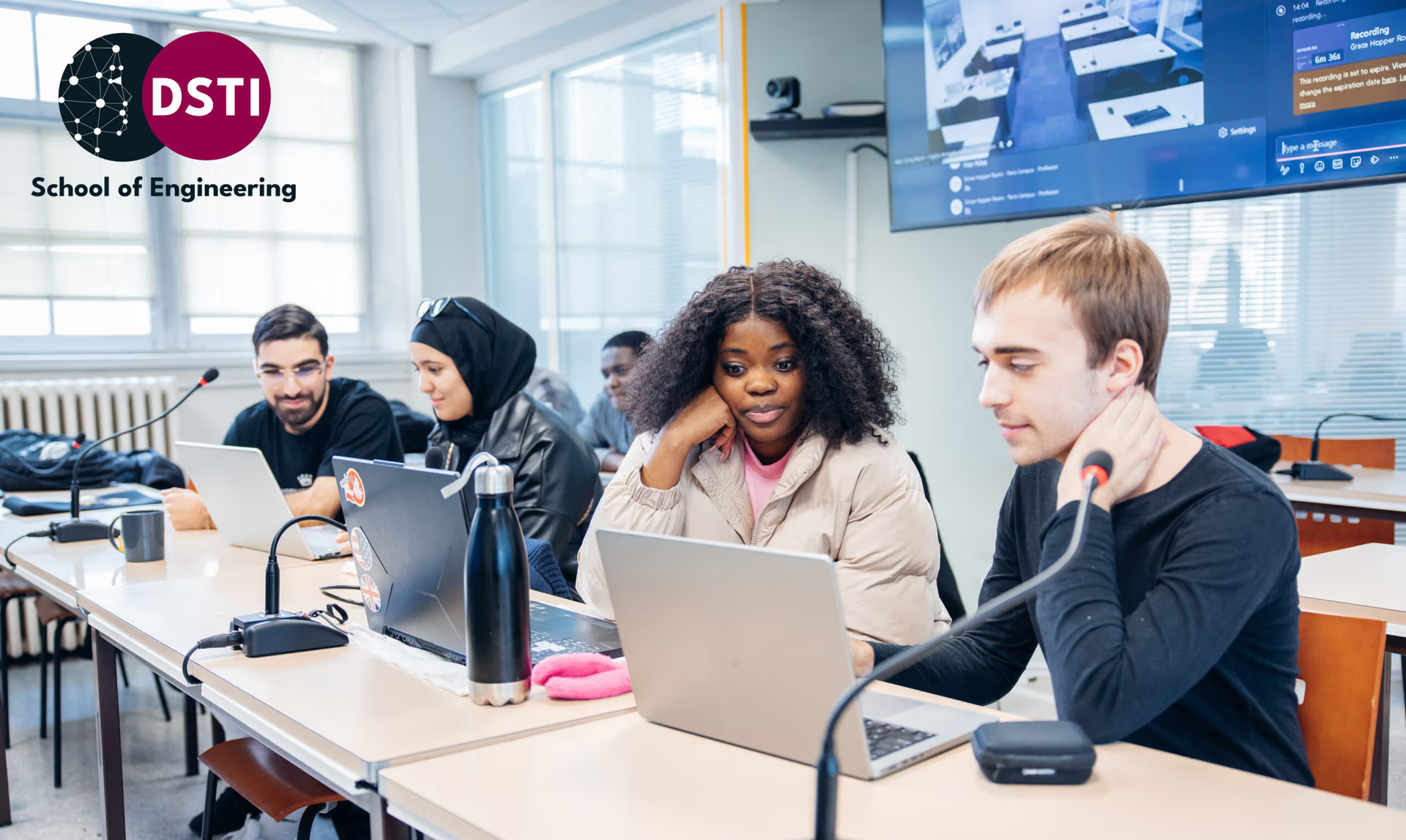
Dans de nombreuses institutions européennes, un Bachelor est structuré en trois ans et 180 ECTS. Cela reflète une tradition éducative dans laquelle les étudiants entrent dans l’enseignement supérieur après une solide formation secondaire générale, puis se spécialisent progressivement dans un parcours undergraduate cohérent.
À DSTI, la première année comprend les enseignements de fondation nécessaires à des étudiants issus de systèmes éducatifs différents. Chaque année enrichit ensuite l’équilibre entre bases théoriques, compétences technologiques, projets, préparation aux certifications et expérience professionnelle.
Concrètement : les étudiants internationaux obtiennent un diplôme européen reconnu, une base technique sérieuse et une plateforme claire pour poursuivre en master ou accéder à des premiers rôles techniques.
Les candidats peuvent lire le programme complet sans perdre la progression : fondations d’abord, puis systèmes, software, data, cloud, cybersécurité, IA et expérience professionnelle.
Computer architecture, processor instruction sets, hardware components, virtualisation, kernel principles and shell-based system automation.
Networking principles, packet routing, addressing, TCP/IP configuration and security mechanisms including VLANs, firewalls and VPNs.
Core AWS and Microsoft Azure concepts, with preparation for AWS Certified Cloud Practitioner or Microsoft Certified: Azure Fundamentals.
Bare-metal installation, system configuration, networking, virtualisation and automation with PowerShell and Linux shell scripting.
Installation, configuration and introductory administration of relational database systems including MySQL and Microsoft SQL Server.
Installation and administration of web servers, SSL/TLS certificates and WordPress-based content management systems.
Administration of on-premises, cloud and hybrid collaboration environments using Active Directory, Azure AD, Exchange, Teams and SharePoint.
Logic, sets, combinatorics, sequences, limits, continuity, differentiation and the core theorems needed for engineering studies.
Fundamental data structures and algorithms, implemented in C with manual memory management and in VBA for Excel.
Relational modelling, normalisation, SQL queries, joins, aggregation, subqueries and an introduction to programmatic SQL.
French for non-native speakers or practical business English for students strengthening professional communication.
Word, Excel, PowerPoint and Outlook skills, with focused preparation for Microsoft Office Specialist: Associate (Excel).
The development of computing, AI, networks, large-scale data systems and connected objects in their social and political contexts.
Energy fundamentals, production, distribution, heat transfer, electricity, storage and optimisation across renewable and non-renewable systems.
Core networking concepts and practical labs preparing students for the Cisco Certified Network Associate (CCNA) certification.
AWS cloud services and architecture, with preparation for AWS Certified Solutions Architect – Associate.
Deployment, security, updating and management of Windows Server workloads across on-premises, hybrid and Azure environments.
Administration and automation of Linux and Windows systems, including filesystems, network services, security and maintenance.
Object-oriented development in Java and C++, covering JVM concepts, multithreading, data access, pointers, memory management and hardware fundamentals.
Object-oriented programming, UML-based software architecture and the foundations of C# development.
Relational databases, advanced SQL, stored procedures, triggers, dynamic SQL and practical work with Microsoft SQL Server.
Arithmetic foundations and modern cryptography, including hash functions, RSA principles, security and practical examples.
Professional English for communication, sector vocabulary and effective interaction in English-speaking work environments.
Double-entry accounting, French and Anglo-Saxon approaches, balance sheets, income statements and operating and fixed-asset accounts.
Climatology, climate change and environmental impacts, explored through scientific principles and practical examples.
Derivation, integration, linear algebra, trigonometry, complex numbers and computer-based modelling.
Security across Azure identity, access, networks, storage, computing and databases, with preparation for the Azure Security Engineer Associate certification.
Linux architecture, installation, command-line tools, filesystems, shell scripting, networking, security and system administration.
DevOps tools and practices including monitoring, service discovery, containers, automation, GitHub, Jenkins, Kubernetes and continuous integration.
HDFS, resource and workflow management, ETL, dataflows, scalable messaging, Spark processing and data exploration.
Descriptive statistics, probability and applied data analysis using R, providing a foundation for machine learning.
Professional Python practices for building reliable, reproducible data pipelines for analytics and AI.
Full-stack development with HTML, CSS, JavaScript, PHP, databases, REST APIs, MVC and Node.js, using professional testing and code organisation.
English vocabulary, grammar, syntax and oral and written comprehension for certification preparation.
Project lifecycle management and practical use of traditional and Agile delivery approaches.
CRM data management and preparation for Exam PL-200: Microsoft Power Platform Functional Consultant.
Data-driven personal branding and professional visibility, using LinkedIn to build a clear digital identity and career roadmap.
Key commercial and intellectual-property concepts, risks and good practices for digital and AI professionals.
EU and US data privacy and security frameworks, with comparison of common-law and code-law approaches.
Self-awareness, assertiveness, relationship management, continuous feedback, coaching and employment rights and responsibilities.
IT sustainability and ethics, including data-centre energy use, AI impact, efficient computing, edge computing, blockchain and 5G.
A structured internship experience in which students apply their technical knowledge in a professional setting, develop professional responsibility and validate 10 ECTS toward graduation.
Les certifications professionnelles sont intégrées au parcours du Bachelor, ce ne sont pas des compléments facultatifs. Les étudiants valident trois certifications reconnues sur l’ensemble du programme : deux certifications fondamentales en Année 1, puis une certification technique avancée avant l’obtention du diplôme. La progression et la diplomation restent liées à ce parcours de certification.
Le parcours BSc Computer Science & Engineering utilise les certifications professionnelles pour rendre les compétences techniques visibles auprès des employeurs. Dès l’Année 1, les étudiants font certifier leurs fondamentaux en productivité et cloud ; les Années 2 et 3 approfondissent ensuite les systèmes, les réseaux et la sécurité avant la certification avancée.




Contexte de cours : Preparation for the Microsoft Office Specialist: Associate Certification
Les étudiants valident Microsoft Office Specialist: Associate (Excel) comme première des deux certifications fondamentales de l’Année 1.
Site de la certificationContexte de cours : Fundamentals in Cloud Computing
Durant l’Année 1, les étudiants valident également une certification fondamentale en cloud parmi les options préparées AWS ou Microsoft Azure.
Site de la certificationContexte de cours : réseaux, cloud, systèmes, Linux, sécurité Azure ou CRM Data Management
Durant les Années 2 et 3, les étudiants préparent et valident une certification technique avancée cohérente avec leur parcours et leur profil de diplômé.
Site de la certificationLe parcours Bachelor ne publie pas de liste libre d’alternatives : il s’agit des options de certification préparées et utilisées dans le parcours académique.
MicrosoftAWSMicrosoftCiscoAWSMicrosoftMicrosoftLinux Professional InstituteMicrosoftLe parcours prépare à la fois l’entrée dans des rôles techniques professionnels et la poursuite d’études de niveau master.
Les diplômés apprennent à identifier, formuler et résoudre des problèmes complexes en mobilisant les principes de l’ingénierie, de la science et des mathématiques. Ils apprennent aussi à communiquer efficacement, travailler en équipe, analyser des données et exercer un jugement d’ingénierie.
DSTI peut signer des conventions pour des stages pertinents en France ou à l’étranger, sous réserve de validation par la Direction des Études. C’est la voie principale pour les étudiants On-Campus et Live Streamed : les stages peuvent se faire en France, dans le pays d’origine ou sur un autre marché pertinent lorsque la mission est cohérente avec le programme.
Un stage local cohérent peut être la bonne voie professionnelle lorsqu’il correspond aux objectifs du BSc.
 Alternative structurée
La voie CRCC Asia propose un parcours structuré de stage de trois mois à l’étranger pour les étudiants qui souhaitent une expérience internationale organisée.
Voir CRCC AsiaLes étudiants sont accompagnés sur le CV, les candidatures et le positionnement professionnel avant l’entrée sur le marché du travail ou la poursuite d’études.