
Our campus sits inside one of Sophia’s landmark buildings.
Templiers Valley gives DSTI a setting that matches the school’s identity: technical, international, quietly ambitious and deeply anchored in Sophia-Antipolis.
From a computing giant’s R&D centre to DSTI.
Built in the 1980s by Digital Equipment Corporation, the building later became associated with Compaq and Hewlett-Packard. Since 2015, it has housed DSTI in a place where serious engineering work has been part of the story for decades.



950 Route des Colles
06410 Biot, Alpes-Maritimes, France
Inside Sophia-Antipolis, minutes from the coastline and Nice Côte d’Azur Airport.
The campus sits at 950 Route des Colles in Biot, within the Sophia-Antipolis technology park and close to the main engineering, research and business corridors of the French Riviera.
Want to understand the lifestyle around DSTI Sophia-Antipolis?
The campus belongs to a wider French Riviera student experience: coastline, mountains, markets, culture, sport and everyday public life from Menton to Saint-Tropez.
Study where technology is built, standardised and operated.
For DSTI students, Sophia-Antipolis is a living reference environment: companies, laboratories, standards bodies and campuses concentrated on the same plateau.
Global technology names, research laboratories and standards bodies.
Amadeus was born in Sophia-Antipolis in 1987 and remains one of the park’s emblematic technology companies. Around DSTI, the ecosystem includes international engineering groups, public research institutions and organisations that shape technology standards.












From start-ups to global technology groups.
The park gives students a concrete sense of what digital engineering looks like outside the classroom.
Public and private laboratories nearby.
Inria, CNRS-linked laboratories, engineering schools and universities contribute to a research-rich environment.
Where global technologies are shaped.
ETSI and the European host of W3C connect Sophia-Antipolis to telecommunications and Web standards used worldwide.
A place where people think deeply and build seriously.
Sophia-Antipolis and the French Riviera are not only a technology-company environment. They are also anchored in mathematics, physics, Earth sciences, space science, marine science and observatories of international standing — with some examples highlighted below.
For DSTI, this matters: strong digital engineering is built on scientific depth.
The region’s strength is not only that technologies are implemented here. Ideas are modelled, measured, tested and formalised here too. These are some examples of the mathematics and applied-sciences institutions that make the Côte d’Azur ecosystem credible for serious digital engineering.

Laboratoire J.A. Dieudonné
Université Côte d’Azur’s mathematics laboratory, with international-level work across fundamental mathematics, applied mathematics and interactions with other disciplines. Many DSTI professors come from, or are connected to, this wider mathematical ecosystem.

I3S Laboratory
A CNRS and Université Côte d’Azur joint research unit in digital sciences at the heart of Sophia-Antipolis, spanning computer science, signals, systems, networks, software, knowledge systems and complex models.

Center of Modeling, Simulation and Interactions (MSI)
Université Côte d’Azur’s centre for modelling, scientific computing and data science support, training and shared computing resources. Its current Director, Prof Didier Auroux, is also a DSTI professor.

Géoazur
A multidisciplinary laboratory combining Earth sciences, geophysics, geology, geodesy, astronomy, space-related observation and instrumentation — a reminder that data, modelling and measurement also serve the physical world.

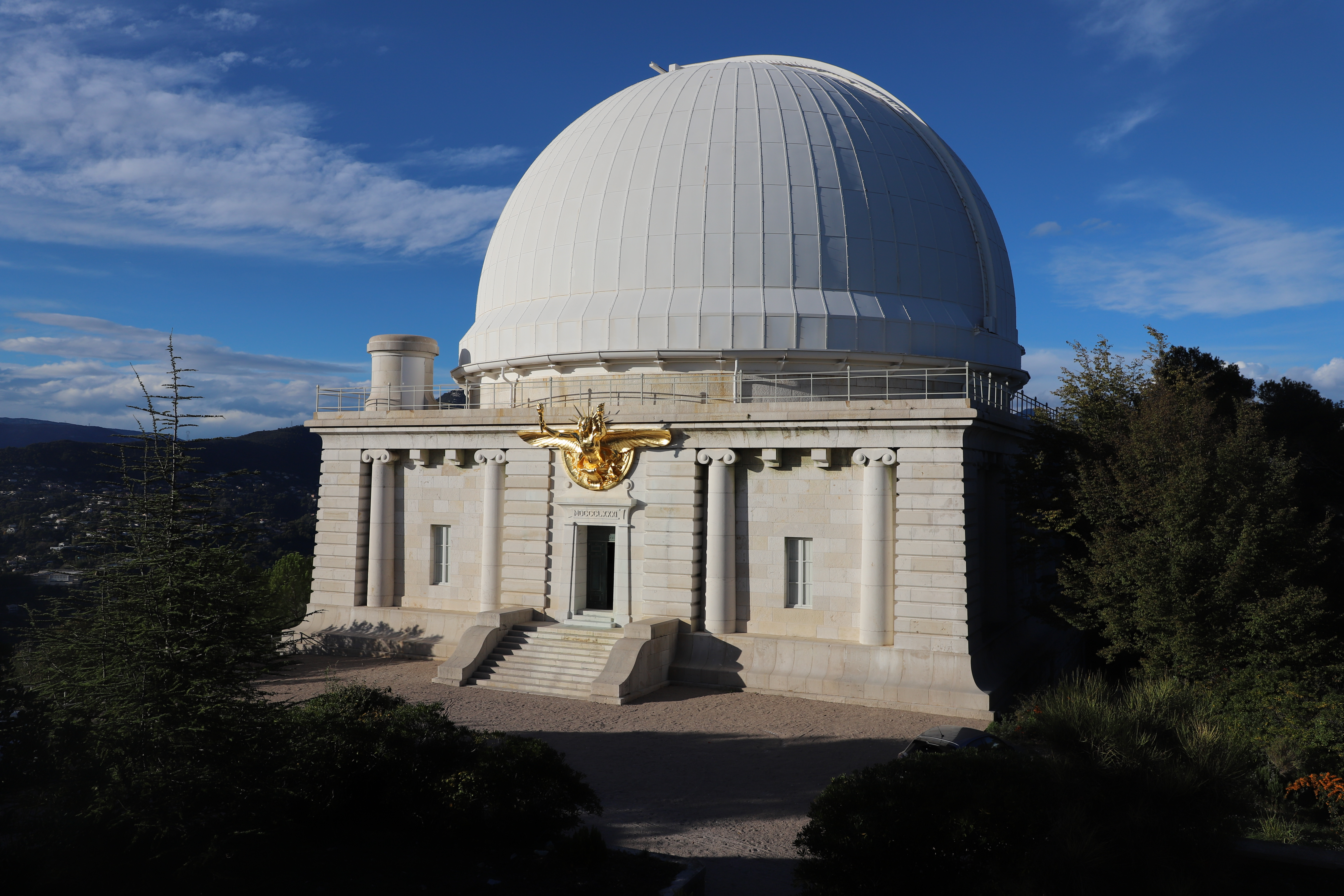
Observatoire de la Côte d’Azur
An international research centre in astronomy, geosciences and related instrumentation, involved in major scientific collaborations including gravitational-wave science around Virgo.

Nice Institute of Physics
A physics institute with strength in fundamental physics, photonics, waves, complex media and nonlinear dynamics — part of the Riviera’s scientific depth beyond software alone.

Inria Centre at Université Côte d’Azur
A major computer science and digital-science research centre in the Sophia-Antipolis ecosystem, connecting algorithms, software, data, AI and applied research.

Institut de la Mer de Villefranche
A marine-science institute on the Côte d’Azur, showing another dimension of the regional scientific environment: ocean observation, living systems, measurement and environmental data.