Transforming Healthcare with AI: Early Brain Tumor Detection Using MRI Scans by a DSTI Student

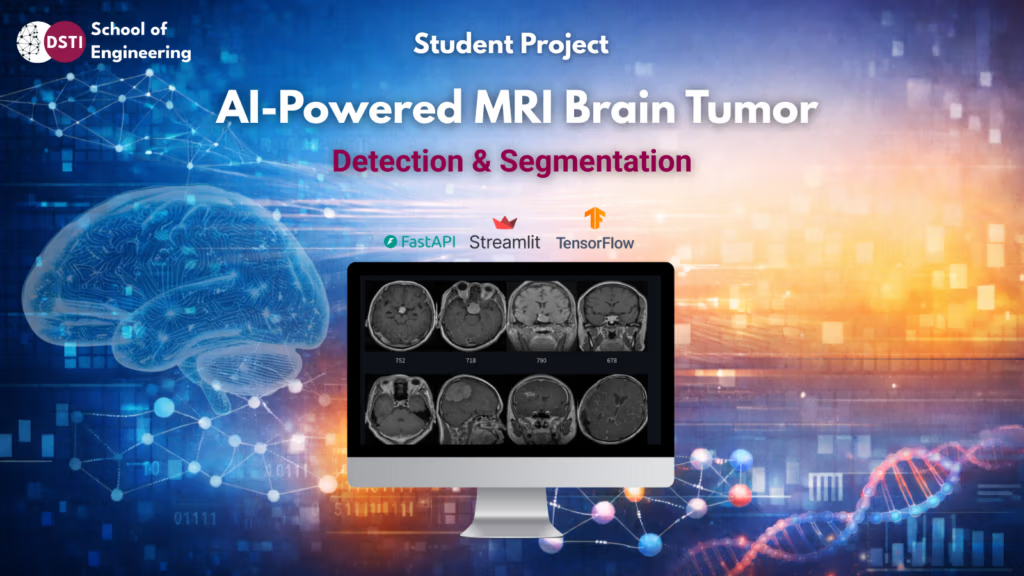
Timmothy Dangeon, a student in DSTI’s MSc in Data Science & AI, has developed a deep learning solution for the early detection of brain tumours. Using the EfficientNetB0 model, this project demonstrates how AI can enhance the accuracy and efficiency of diagnosing brain tumours, including glioma, meningioma, and pituitary tumours, from MRI scans. 

Early and accurate detection of brain tumours is crucial for improving patient outcomes. This project tackles this challenge by automating the detection process using AI, reducing the potential for human error and accelerating diagnosis. 

As the healthcare industry increasingly turns to AI for diagnostic tools, this project stands out as a prime example of how deep learning can be applied to medical imaging, offering a solution that is both timely and necessary in today’s medical landscape. 

Methodology: Leveraging Advanced Tools and Techniques

Technological Stack:

The project is built using Python, a preferred language in Data science and AI. Timmothy employed TensorFlow and Keras for model development, OpenCV for image processing, and FastAPI to create an API interface. Streamlit was used to build a user-friendly web application, making the model accessible to users for testing. 

Data Selection and Processing:

The project utilised a dataset of 7,023 MRI scans, including T1-weighted, T2-weighted, and FLAIR images, sourced from Kaggle. This comprehensive dataset was selected for its variety and volume, providing a solid foundation for training the model to distinguish between different types of brain tumours and healthy tissues. 

EfficientNetB0 Model and Transfer Learning:

Timmothy chose the EfficientNetB0 model for its efficiency and accuracy in image classification tasks. By applying transfer learning, he fine-tuned the pre-trained model to specialize in brain tumour detection, significantly reducing the computational resources required while achieving high performance. 

Project Execution: From Concept to Deployment

Workflow and Implementation:

Pre-processing the Data:

MRI images were pre-processed to remove duplicates and crop unnecessary borders, ensuring that the data was clean and standardized for input into the model. 

Training the Model:

The EfficientNetB0 model was trained on the processed dataset, with checkpoints in place to save the best-performing version based on validation metrics. 

Developing the Web Application:

Fast API was used to manage the backend operations, while Streamlit was employed to create an intuitive front-end interface. This web application allows users to upload MRI images and receive predictions from the model. 

Deploying the Solution:

The final model was deployed on a web platform, where it can be accessed and tested in real-time, showcasing the project’s practical application. 

Challenges and Solutions:

Balancing the dataset to avoid bias towards certain tumour types was a significant challenge. Timmothy used oversampling techniques to ensure that the model was exposed to a balanced representation of all tumour classes during training. 

Outcomes

The model achieved an accuracy of 0.997, a sensitivity of 0.997, and a specificity of 0.999 on the test dataset, demonstrating its reliability in identifying both tumour-positive and tumour-negative cases. Techniques like Grad-CAM were used to visualize the regions of the brain that influenced the model’s predictions, providing additional validation for its accuracy. 

Applications in Healthcare:

This project has the potential to significantly impact the healthcare industry by providing a tool for the early detection of brain tumours. Its open-source nature encourages further research and development, making it a valuable contribution to the field of medical AI. 

Student’s Insight:

Timmothy reflected, “This project has allowed me to combine my pharmaceutical background with AI, creating something that can truly make a difference in healthcare. It’s been a rewarding experience to see how technology can be used to solve real-world problems.” 

Learning Outcomes: Skills and Industry Relevance

Skill Development:

Through this project, Timmothy gained expertise in deep learning, particularly in using TensorFlow and Keras for model development. He also developed skills in data preprocessing and web app deployment, making him proficient in end-to-end project implementation. 

Relevance to Industry:

The skills acquired through this project are highly sought after in both the AI and healthcare industries. As demand for AI-driven diagnostic tools grows, Timmothy’s experience positions him as a strong candidate for roles in these fields. 

Interested in AI and healthcare? Learn more about DSTI’s Applied MSc in Data Science & AI and see how you can work on groundbreaking projects like this.  

More Posts